Chronic Wounds & Bedsores: The Role of Antiseptic Debridement in Faster Healing


Managing chronic non-healing wounds—such as pressure ulcers (bedsores), diabetic foot ulcers, and venous leg ulcers—presents a major challenge for patients, family members, and healthcare providers. When a wound stall in the healing process, simple dressings or basic antiseptic creams are rarely enough to reboot recovery.
To understand why chronic ulcers fail to close, it is important to look at the cellular environment inside the wound bed and understand how specialized wound-irrigation solutions help remove barriers to healing.
Why Chronic Wounds Get Stuck in the Inflammatory Phase
A healthy wound naturally transitions through four phases: homeostasis, inflammation, proliferation (tissue building), and remodeling. However, chronic wounds often become trapped in a continuous, destructive inflammatory loop due to three primary obstacles:
- Slough and Necrotic Tissue: Dead cellular debris builds up on the wound bed, forming a yellowish or dark grey film (slough). This dead tissue acts as a physical barrier that prevents fresh skin cells and granulation tissue from migrating across the wound base.
- Bacterial Biofilms: Bacteria in chronic wounds rarely exist as free-floating single cells. Instead, they secrete a slimy protective matrix called a biofilm that adheres firmly to tissue. Biofilms shield bacteria from antibiotics and the body’s immune system.
- High Exudate & Odor: Infected or necrotic wounds generate excessive fluid (exudate) and foul odors, breaking down healthy surrounding skin (maceration) and causing significant distress to the patient.
The Principle of Chemical Debridement and Antiseptic Cleansing
Before new, healthy tissue can form, the wound bed must be clean, moist, and free of devitalized material. Removing dead tissue and bacterial contamination is known as debridement.
While surgical debridement physically cuts away necrotic tissue, chemical and antiseptic irrigation uses active chlorine compounds—such as Edinburgh University Solution of Lime (EUSOL)—to gently liquefy slough, dissolve proteinaceous exudate, and destroy microbial cell walls on contact.
What Makes EUSOL Solution Effective for Sloughy Wounds?
EUSOL is a classic, clinically established antiseptic irrigation solution prepared from Chlorinated Lime and Boric Acid. It generates fresh hypochlorous acid and free chlorine in precise, controlled concentrations.
When applied as a wet-to-dry dressing or wound irrigator:
- Proteolytic Slough Breakdown: Free chlorine breaks down the peptide bonds in dead proteins, softening stubborn slough and facilitating its painless removal during dressing changes.
- Broad-Spectrum Antimicrobial Power: Rapidly destroys bacteria (including resistant strains), fungi, and viruses without encouraging antibiotic resistance.
- Odor Control: Instantly neutralizes offensive odors caused by anaerobic bacterial colonization in necrotic tissue.
The Compounding Advantage: Freshness and Stability
Because active chlorine compounds degrade over time when exposed to heat, air, and light, commercial shelf-stable solutions often lose potency before use.
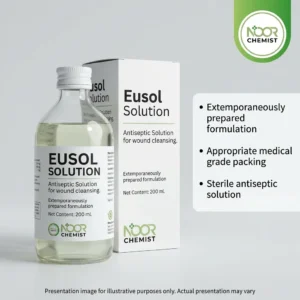
At Noor Chemist – Compounding Pharmacy, EUSOL Solution is extemporaneously compounded fresh upon order. Fresh preparation ensures exact active chlorine concentration and maximal antiseptic and debriding activity when applied to the wound bed.
Featured Product Solution: EUSOL Solution
For effective wound cleansing, slough removal, and infection control in pressure sores and diabetic foot ulcers, Noor Chemist provides EUSOL Solution.
Custom-compounded by our pharmaceutical team, EUSOL Solution delivers:
- Freshly Compounded Potency: Mixed to precise pharmacopeial ratios to ensure high active chlorine availability.
- Targeted Debridement: Ideal for sloughy, foul-smelling, or infected stage II–IV pressure ulcers and chronic leg ulcers.
- Affordable Clinical Care: Provides hospital-grade wound bed preparation at a fraction of the cost of complex synthetic dressings.
Best Practices for Using EUSOL in Wound Care Protocols
To ensure safety and optimal therapeutic outcome when managing chronic ulcers at home under medical supervision:
- Flush and Cleanse: Gently irrigate the wound bed with fresh EUSOL Solution to wash away loose debris and purulent drainage.
- Apply Wet Dressings for Sloughy Beds: Soak sterile gauze in EUSOL Solution, squeeze out excess liquid so it remains damp (not dripping), and pack it loosely into the wound cavity. Cover with a dry sterile secondary dressing.
- Change Regularly: Change dressings once or twice daily according to exudate levels and clinical guidance.
- Discontinue When Clean Granulation Appears: Once the wound bed is clear of slough and vibrant pink/red granulation tissue appears, transition to mild saline irrigation and barrier protection to support delicate new tissue growth.
Take Charge of Complex Wound Healing
Overcoming chronic wound stagnation requires systematic wound bed preparation. By incorporating freshly compounded EUSOL Solution into structured wound protocols, caregivers can eliminate slough, control infection, and pave the way for tissue closure.
Explore or order EUSOL Solution directly from Noor Chemist with nationwide delivery across Pakistan.